Deciphering the fertility test: what your results really mean
A fertility test is not just a biological evaluation, but a long journey towards the coveted joy of conception, combining emotions, timing and science.


When you first hear the words "low AMH", you feel as if the ground is shifting beneath your feet. You may not understand exactly what it means, but you immediately sense that it's not good news.
The doctor's tone may be calm, but his words hit hard. You were healthy, hopeful, ready to welcome a baby into your life... and suddenly, everything becomes uncertain. Those three words can make you doubt your body, your future and your dream of becoming a mother.
Read this blog to understand what low levels of anti-mullerian hormone (AMH) really mean and how they influence your fertility. Thanks to advances in modern reproductive science, treatments for low AMH are now more effective than ever, offering new hope to all those who dream of becoming parents.

Anti-mullerian hormone, or AMH, is a protein released by the tiny follicles in your ovaries. It is used to estimate your ovarian reserve, i.e. the number of oocytes you have left.
Learning that your AMH level is low can be both confusing and difficult to accept. You might begin to wonder if this means you're out of options. But the truth is, that's not the case.
A fertility specialist can help you see the big picture. As Dr. Nathalie Josso, a leading researcher at INSERM (France), explains:
"AMH is produced by the ovarian follicles that contain the oocytes. The more follicles there are, the higher the AMH level in the blood."
- Nathalie Josso, INSERM
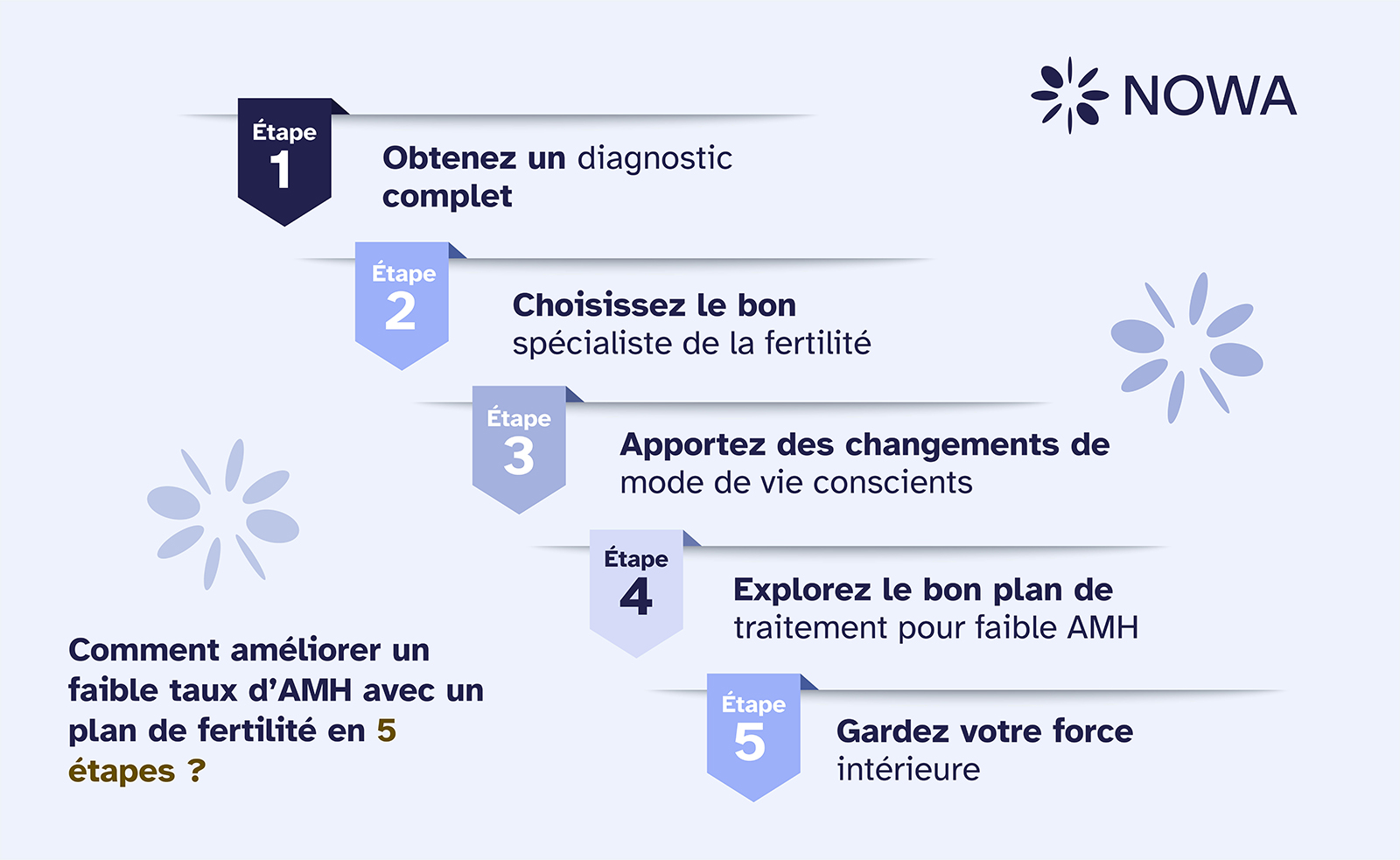
Once you understand this, fear often gives way to greater clarity about your fertility and treatment options. Instead of panicking, focus on accurate diagnosis and thorough testing. Understanding why your AMH is low will help determine how it should be managed.
Many women mistakenly believe that low AMH levels or a low oocyte count mean they are less likely to conceive. Yet, according to many fertility specialists, this hormone measures only the quantity, not the quality, of oocytes.
Many factors can influence your AMH levels without you even realizing it. Identifying them early can help you protect your fertility and plan more intelligently.
Remember: While you can't expect your AMH levels to rise overnight, these factors can help your doctor develop a personalized treatment plan to achieve your fertility goals.
Coping with diminished ovarian reserve (DOR) is often an invisible struggle. On the outside, everything seems fine, but on the inside, you carry fear, confusion and deep, silent sadness.
Understanding that other women have gone through this journey and succeeded is the first step towards healing. Here's a glimpse:
If you've been told your AMH is low, don't stop there. Ask your doctor for a full fertility evaluation, including :
Not all clinics take the same approach to women with diminished ovarian reserve. It's essential to consult a specialist experienced in personalized protocols, rather than standardized treatments that aren't right for everyone.
According to Dr Anne-Sophie Maget, gynecologist specializing in AMP (Assistance Médicale à la Procréation):
"In the case of low levels of anti-Müllerian hormone in women, quality is more important than quantity. Each oocyte is important.
Although medical treatment is important, your lifestyle plays an essential role in egg quality and hormone balance. Small, regular changes can significantly improve your chances of success:
Nutrition: focus on antioxidant-rich foods such as berries, spinach and walnuts. Add omega-3s from fish or flaxseed.
Supplements: ask your doctor if CoQ10, vitamin D and folate can support the health of your oocytes.
Stress management: practice meditation, yoga or deep breathing to reduce cortisol, which disrupts reproductive hormones.
Sleep & Hydration: get regular sleep and stay well hydrated to support a healthy hormonal balance.
Once you and your doctor understand your results, the next step is to choose a treatment that's right for you.
For lower-than-normal AMH levels, a mini-IVF protocol works particularly well. It uses fewer drugs, focuses on quality rather than quantity, and reduces the stress on your body.
Other possible options include :
Your doctor will guide you according to your age, medical history and the way your ovaries react. Remember: there's no one-size-fits-all formula. The best treatment is the one designed for you.
Tip: ask your doctor about a mini-IVF or gentle stimulation protocol. It often yields better oocytes for women with low AMH levels, while reducing the drug load.
The emotional aspect of this journey is just as important as the medical one. Low AMH levels can cause anxiety, loneliness or a sense of failure, but your emotional well-being plays a powerful role in recovery and treatment outcomes.
Many women find hope by joining support groups or talking to others in the same situation. Some testimonials can boost your confidence.
This is the story of Amélie, 34, with an AMH level of 0.8 ng/mL. After two years of trying, she became pregnant thanks to a personalized mini-IVF protocol. Her words after her first ultrasound summed it all up:
"I've spent months crying over numbers. Today, I heard a heartbeat."
His success shows that numbers don't define your destiny. Your perseverance and faith do.
Here's what really matters during your fertility journey:

A low AMH level doesn't extinguish your dream of parenthood. Understanding your results helps you redefine your path and act accordingly. Conception remains entirely possible, thanks to the right medical expertise, a healthy lifestyle and renewed emotional strength.
You have every reason to be hopeful, even if your anti-müllerian hormone levels are low. Every day, advances in reproductive science and personalized treatments help people like you to rewrite their history.
Low AMH is not the end - it's a new path to motherhood. Your journey may be different, but it can lead to the same wonderful outcome: a healthy pregnancy and a baby in your arms.
Consult a trusted specialist to analyze your AMH results and get the right advice!

Personalized suggestions based on your reading and fertility goals - curated by Nowa's team and algorithm.

With a decade of experience in reproductive medicine, Dr. Maget combines clinical expertise and data-driven knowledge to help individuals and couples approach their fertility journey with confidence.
.svg)
.svg)
There is no proven method for significantly increasing AMH. However, a healthy lifestyle can support fertility. An optimal diet, good stress management, quitting smoking and maintaining a balanced weight can all help improve the health of your ovaries.
AMH may not increase dramatically with dietary supplements, but your overall reproductive function may benefit.
Yes, many women with low AMH levels conceive naturally or through fertility treatment. Even if a low level indicates a reduced number of follicles, ovulation and the production of healthy oocytes are still possible.
With the right timing, appropriate follow-up, a balanced lifestyle and medically assisted reproduction (MAP) techniques, the chances of conception remain high.
Consult a specialist if :
Early consultation is sometimes useful if you have had previous fertility problems, known risk factors (such as endometriosis or surgery), or low AMH levels requiring a precise diagnosis and treatment plan.
You must undergo a complete fertility workup, including :
It is also essential to examine the structure of the uterus and fallopian tubes, and to evaluate your partner's spermogram. Checking prolactin levels, as well as other hormonal and metabolic factors, helps establish a comprehensive fertility profile to guide next steps.
No. A low AMH level indicates reduced ovarian reserve, but it doesn't automatically mean infertility. It simply means that fewer follicles remain and fertility may decline earlier.
Many women with low AMH conceive naturally or with medical support. Sometimes, factors such as oocyte quality, partner fertility or certain physical or emotional conditions can also influence conception.
Discover unique information about your body with Nowa's personalized fertility test - designed by experts and accelerated by our technology.
Do the testTake the NOWA fertility test to find out in just 3 days.
Do the test



Choosing an assisted reproductive technology clinic abroad can quickly become confusing. Criteria, pitfalls to avoid, personalized approaches: we help you see clearly and make a choice that is right for your situation.
Understand low AMH, its impact on fertility and treatment options. Find out how to improve egg quality and increase your chances of conception.

A fertility test is not just a biological evaluation, but a long journey towards the coveted joy of conception, combining emotions, timing and science.